
Part 2 of 3 in The Logic of Relationships · 5 min read
The short version
- At the centre of your life is a nucleus: you and your conscience (or God), where there are no secrets.
- Everyone else sits in an orbit, closer or farther by how permanent the relationship is: children, partner, parents, true well-wishers, then everyone else.
- Never lie in any orbit. The orbits decide only how much of the truth each one needs.
Once a relationship is established, the question changes from “should this person be in my life?” to “where do they belong in it?”
In The Anatomy of a Relationship and The Anatomy of a Business Relationship I described four connects that decide whether a relationship can work. This model picks up after that. It borrows its shape from the atom: a nucleus at the centre, and orbits at different distances from it.
The nucleus: you and your conscience
An atom’s nucleus holds protons and neutrons. In this model the proton is you, and the neutron is your conscience.
The nucleus is the one place with no secrets: complete honesty, no fear of judgement, no retaliation, no revenge. Everything you do is known there, because you cannot hide it from yourself.
Some people find it hard to separate their conscience from their physical self. For them, God is a good alternative, and often an easier one. Nothing prevents having both; I do, and it makes the nucleus stronger.
The physics fits. A neutron carries no electric charge, yet it supplies the strong nuclear force that keeps the protons from pushing the nucleus apart. A conscience has no agenda of its own, yet without it the self does not hold together.
The orbits
Everyone else in your life sits in an orbit around the nucleus, closer or farther by the quality and permanence of the relationship. This is my order; treat it as a sample and set your own.
| Orbit | Who | Usual size | Why here |
|---|---|---|---|
| 1 | Your children | As many as you have | The most permanent relationship there is. Young children never chose to depend on you; adults can choose, children cannot. Once they are grown, permanence keeps them here |
| 2 | Your soulmate | Usually one | The partner who matches you on the four connects. Some people meet different connects through more than one person |
| 3 | Your parents | Usually two | Fixed by birth, and normally limited to them |
| 4 | True well-wishers | Very few | The people you can approach in your low times. Not necessarily blood relatives |
| 5 and beyond | Everyone else, by quality | Growing outward | Friends, colleagues and community, with acquaintances in the outermost orbit |
The order is about permanence, not about who matters more. Fairness and doing the right thing are not optional in any orbit. And the orbits strengthen each other: a strong orbit 2 makes orbit 1 stronger.
Any orbit can be empty. Someone without children, or whose parents have passed, still has an atom; those orbits simply hold no one. There can be bad apples in any circle, parents included. If someone does not fit an orbit, leave it empty; an empty orbit does not disrupt the model. Those who believe the partner should come before the children can swap orbits 1 and 2, and the model loses none of its value. In the outer orbits, people move inward or outward over a lifetime as relationships deepen or fade.
Whether you picture these as orbits or as clouds does not matter. The point is distance from the nucleus.
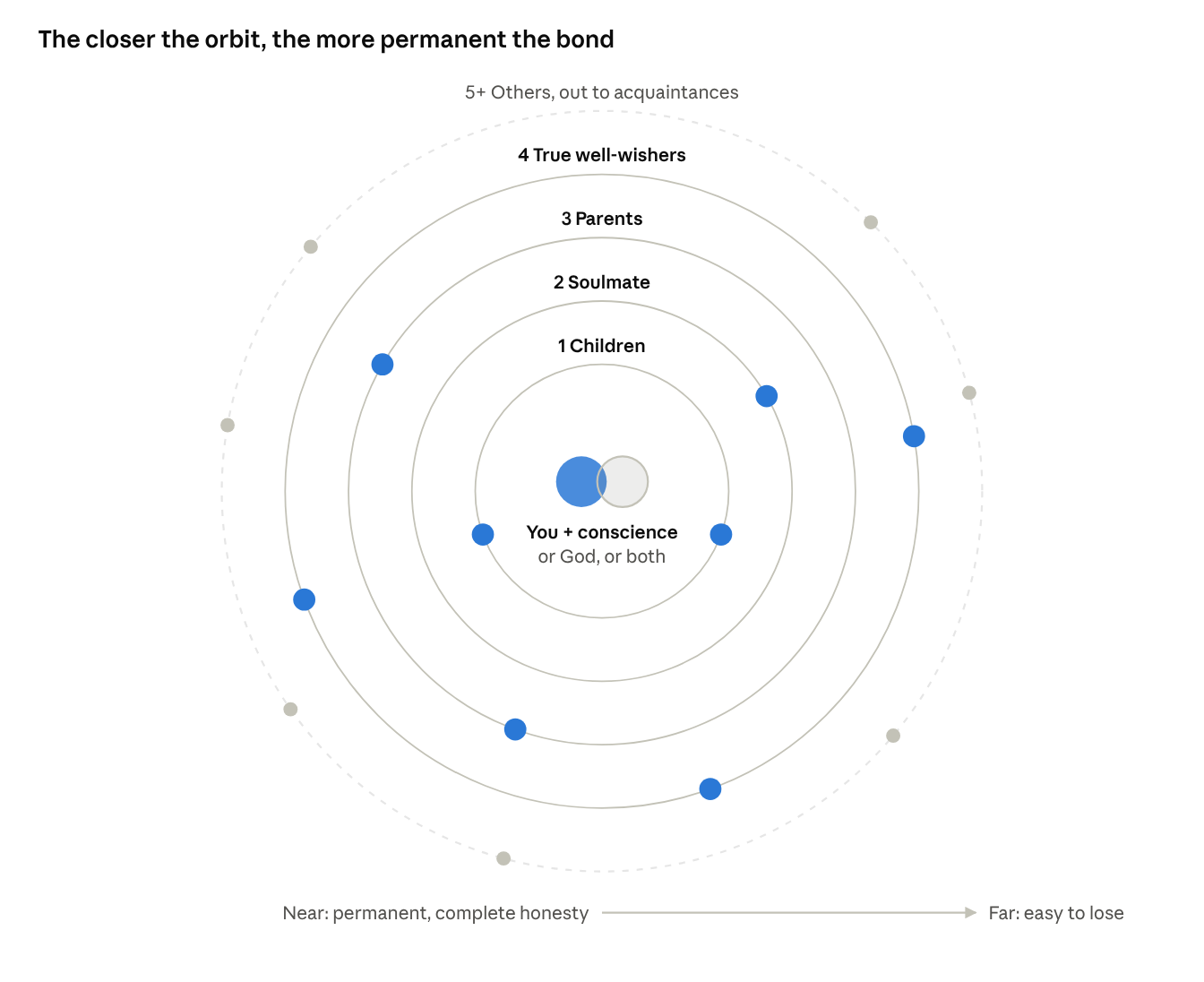
The nucleus holds you and your conscience. Each orbit outward holds fewer permanent bonds and more people, until the outermost cloud of acquaintances.
What the physics teaches
The atom is a metaphor here, and physicists replaced fixed orbits with probability clouds a century ago. That does not matter for this model, which is only about near and far. But several real properties of atoms carry over well.
- Inner shells are small. An atom’s first shell holds 2 electrons, the next 8, the next 18. The orbits closest to you also hold the fewest people.
- Inner electrons are the hardest to remove. It takes far more energy to pull an electron from an inner shell than from the outermost one. Children stay in orbit 1 for life; an acquaintance drifts away without anyone noticing.
- Bonds form at the outer edge. Atoms join into molecules through their outermost electrons. People join families, teams and communities the same way: through shared outer orbits, while each nucleus stays its own.
- A nucleus without neutrons flies apart. Beyond the simplest atoms, protons alone cannot hold together. A self without a conscience is unstable in the same way.
Others who drew circles
I did not find this model elsewhere, but the idea of the self at the centre with relationships in rings is old, and appears in very different traditions.
| Framework | What it shares | What differs |
|---|---|---|
| Hierocles’ circles, Stoic, 2nd century CE | The mind at the centre, then family, relatives, community, country, humanity | A duty to draw outer circles inward; no conscience or God in the centre |
| Fei Xiaotong, Xiangtu Zhongguo, 1947 | Chinese social ties as ripples from a pebble thrown into a lake, with the self at the centre | A description of a society, not a personal guide |
| J. L. Moreno’s social atom, psychodrama | Even uses the word atom: a person and the people tied to them, drawn as a map | Ties marked positive or negative, not ranked in orbits |
| Kahn and Antonucci’s convoy model, 1980 | Three concentric circles of close, closer and closest people that travel with you through life | Placed by felt closeness, not by role |
| Dunbar’s layers | Rings of about 5, 15, 50 and 150 people; the inner 5 are those you turn to in distress | Defined by size and time spent |
What is new here is the nucleus of self and conscience, the honesty that defines it, and orbits set by role and permanence. That a Stoic, a Chinese sociologist, a psychiatrist and an evolutionary psychologist all drew circles suggests the shape is real, whatever language describes it.
The rule across all orbits
Never lie; tell the truth. But a truth does not have to be told just because it is true.
The orbits do not change what is true, only how much of it each one needs. The nucleus holds everything. Each orbit outward hears less, and no orbit ever hears something false.
Two old traditions draw the same line. The Manusmriti (4.138) says to speak the truth kindly, and to speak neither an unkind truth nor a kind lie. In the Abhaya Sutta, the Buddha says only what is both true and beneficial, at the right time; even a pleasant truth goes unsaid if it does no good. Mine is closest to the Buddha’s: always true, and told when there is a need.
Using the model
- Start with the nucleus. Be completely honest with yourself, or with God, before anyone else.
- Draw your own atom. Place the people in your life by orbit. Leave empty orbits empty.
- Match effort to orbit. Give the inner orbits your first commitment, time and protection.
- Notice movement. When someone in an outer orbit shows up in your low times, they may belong in orbit 4.
- Use the four connects at the edge. The Anatomy of a Relationship decides who enters; this model decides where they settle.
I find it hard to follow anything without a reason behind it. This model is my reason for how I place people in my life: a nucleus of honesty, and orbits ordered by permanence. Yours may be ordered differently. The shape, I think, holds for everyone.
Companion posts: The Anatomy of a Relationship and The Anatomy of a Business Relationship.
Leave a Reply
You must be logged in to post a comment.